
Scratches and Dull Spots in High-Traffic Lanes? Refinish or Replace?
QUICK ANSWER: If the dullness and scratches in your hallway, entryway, or the path from the sink to the fridge sit only in the finish layer, a sand-and-refinish (or in mild cases a screen-and-recoat) will bring those boards back to match the rest of the room. If the wear has gone past the finish and into the wood grain itself (cupped edges, visible fiber tear, or boards worn thin enough that the finish won't hold), those specific planks likely need to come out and be replaced before the floor is refinished as a whole. The test is depth, not appearance: a dull, gray-looking lane can often be saved, while a lane with open grain or soft spots usually can't.
How to Tell Finish Wear From Wood-Deep Wear
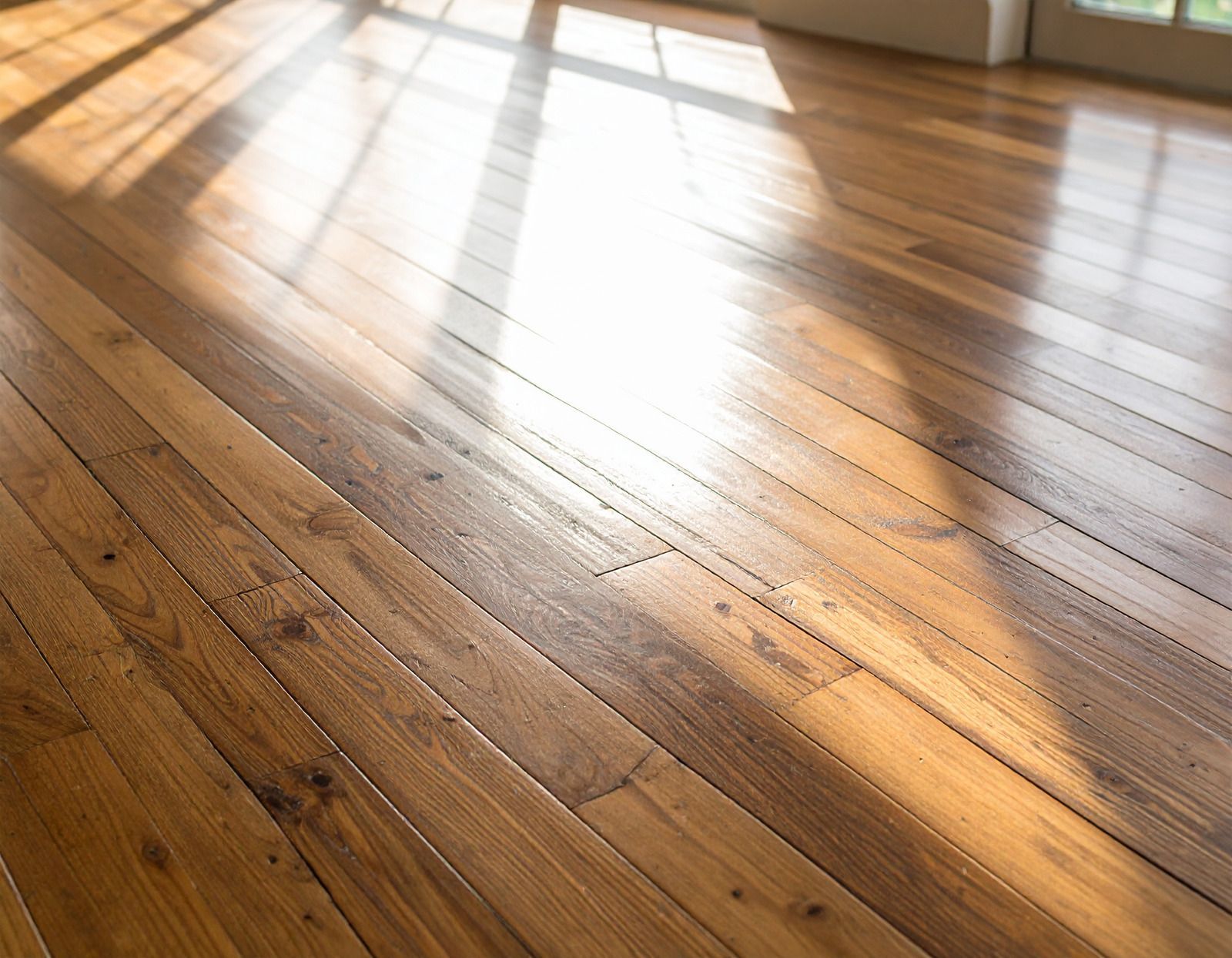
Stand at the end of your hallway or the stretch of floor in front of the kitchen sink and look at it sideways, with light raking across the surface instead of straight down. That angle shows you what a straight-on glance hides: a corridor of dull, hazy, sometimes slightly gray wood running exactly where feet travel, flanked by boards that still hold their sheen. That contrast is almost always finish wear, not wood damage, and it's the most common reason homeowners in traffic-heavy hallways and entries call about refinishing in the first place.
There's a simple way to confirm it before you decide anything. Wet a rag and let a few drops of water fall onto the dullest part of the lane. If the water beads up and sits on the surface, there's still a protective film present, worn thin but present, and refinishing will restore it. If the water soaks in almost immediately and darkens the wood, the finish in that spot is gone and the bare wood underneath is exposed to whatever spills, pet accidents, or mop water comes its way. That second scenario still usually points to refinishing, but it means the clock is running faster than it looks, because open wood grain absorbs moisture unevenly and can start to discolor or fiber-raise the longer it sits unprotected.
Scratches get judged the same way, by depth rather than by how noticeable they look. Run a fingernail across one. If your nail glides over it and you can't catch an edge, it's a finish-level scratch, cosmetic, and gone after a light sand. If your nail catches, or if you can see the scratch continuing into open wood grain rather than sitting on top of a glossy surface, it has gone through the finish and into the board itself. A handful of scratches like that in an otherwise sound floor are still very refinishable, since sanding removes a thin layer of the actual wood surface along with the damaged finish, taking the scratch with it. The concern only shows up when those deeper scratches are concentrated and repeated in the same few feet of lane, because that tells you the wood there has been losing material for years, not just the day you got a new dog.
TIP: Check three or four spots along the lane, not just the worst-looking one — a hallway that looks uniformly dull often has one narrow strip, right where feet actually land stride after stride, that's meaningfully more worn than the rest, and that strip is the one that decides whether the whole run needs board replacement first.
Why Your Hallway Wears Faster Than the Rest of the House
Why Traffic Lanes Wear Faster in Arizona
Every home has high-traffic lanes, such as paths from the front door to the kitchen or garage entry. In Chandler, Gilbert, and Mesa, these areas often wear faster because desert dust, gravel, and dry air increase abrasion. Grit carried indoors acts like sandpaper, gradually dulling the finish under repeated footsteps.
Desert Dust and Grit
Phoenix Valley homes are surrounded by decomposed granite, desert dust, and gravel yards. Tiny mineral particles carried indoors on shoes become abrasive underfoot, creating microscopic scratches with every step. Garage entrances in Queen Creek, Sun Lakes, and Ahwatukee often show faster wear because they handle groceries, bikes, equipment, and frequent daily traffic.
Arizona's Dry Air
Arizona's low humidity keeps interior wood relatively dry, particularly in homes using refrigerated or evaporative cooling. Dry conditions can make finishes more susceptible to fine cracking and scratching from repeated grit exposure. In slab-foundation homes, floors near exterior doors and sunny windows may experience especially noticeable dryness and accelerated surface wear.
Sun and UV Exposure
Direct sunlight adds another source of floor deterioration. Hallways near west-facing windows or foyers beneath skylights can receive hours of UV exposure, especially in Scottsdale and Paradise Valley homes. UV rays gradually break down polyurethane finishes, making them duller and more vulnerable to scratching while also changing the wood's appearance over time.
Combined Wear and Refinishing
Arizona floors often experience both heavy traffic and intense sunlight along the same lanes. Grit scratches the finish while UV exposure weakens and changes its appearance. Refinishing addresses both problems by removing the damaged surface layer and applying fresh finish, restoring a more consistent appearance across the affected flooring.
How Many Times These Boards Can Come Back
Every time a hardwood floor is sanded, a thin layer of actual wood comes off with it, typically somewhere between a thirty-second and a sixteenth of an inch per pass, not just the finish sitting on top. That's a deliberate part of the process: leveling old scratches, removing the UV-damaged surface, and creating a clean, open-grain surface for new stain and finish to bond to. It also means every refinish is a withdrawal against a limited account, and how much is in that account depends entirely on what kind of hardwood is under your feet.
Solid hardwood is the deep end of the pool. A ¾-inch solid plank typically carries somewhere around a quarter inch or more of usable wood above the tongue-and-groove joint, and that gives most solid floors room for six to eight full sandings over a normal service life — sometimes more, sometimes fewer, depending on how aggressively past refinishing jobs were done. Once the wear layer above the tongue drops below roughly 3/32 of an inch, sanding stops being safe, because there isn't enough wood left to level the surface without risking exposed nails, a weakened tongue, or sanding straight through into the subfloor.
Engineered hardwood runs a very different math, and it's worth knowing which one is under your traffic lane before you assume a refinish is automatic. Engineered flooring is a real hardwood wear layer bonded over a plywood or high-density fiberboard core, and that top layer can range anywhere from about a millimeter to six millimeters depending on the product. A thicker wear layer, in the four-to-six-millimeter range, behaves close to solid hardwood and can typically handle several full refinishes over its life. A thinner veneer, in the one- or two-millimeter range common in budget engineered products, might tolerate only one light refinish, or in some cases none at all, because there simply isn't enough wood above the core to remove a leveling layer without exposing the plywood underneath. If you don't know which you have, a flooring professional can check remaining thickness at a discreet spot, like inside a closet or under a vent cover, before committing to a full sand.
WARNING: Never assume a screen-and-recoat or full sand is safe just because the floor "looks fine" everywhere except the traffic lane — engineered floors with a thin wear layer can look perfectly healthy on the surface while having almost nothing left underneath, and a sanding pass on a floor like that can go straight through the veneer in the very spot you were trying to fix.
Weighing Refinish Against Replacement in the Lane Itself
Once you've sorted finish-level wear from wood-deep wear, and confirmed whether the floor is solid or engineered, the decision usually comes down to three practical questions specific to that lane.
Uniformity
A traffic lane that's dull or lightly scratched but remains structurally even is usually ideal for refinishing. If there are no soft spots, cupping, or uneven boards, sanding can level the surface, blend worn areas into surrounding wood, and restore a consistent color and sheen across the floor.
Localized Deep Damage
If only a few boards beneath heavy foot traffic have deep gouges or moisture staining beyond sanding's reach, those individual boards can often be replaced. Matching new material and refinishing the entire section helps the replacement boards blend naturally, avoiding the expense and disruption of replacing the entire floor.
Moisture-Related Wear
Cupping, where board edges sit higher than their centers, often indicates moisture rather than ordinary traffic wear. If it appears near plumbing, such as kitchens or bathrooms, the source should be investigated and corrected first. Refinishing before resolving moisture can cause boards to cup again, potentially undoing the completed work.
Age of the Finish
The finish's age also influences whether refinishing makes sense. A floor refinished within recent years that shows wear in one lane is generally a strong candidate for localized attention. Conversely, a floor untouched for more than a decade may need complete refinishing, since aging finish across the surface can require broader restoration.
Frequently Asked Questions
Can a screen-and-recoat fix a dull, scratched hallway, or does it need a full sand?
A screen-and-recoat, which lightly abrades the existing finish and applies a fresh topcoat without sanding into the wood, works well when the wear is shallow and consistent, meaning the finish is dull and lightly scratched but hasn't worn through anywhere in the lane. It's a faster, less invasive option than a full sand-and-refinish. It won't work if any scratches reach into the wood grain or if the water-bead test shows bare, unprotected wood anywhere in that stretch, because recoating over exposed wood traps in whatever is already on the surface rather than fixing it.
Why does my entryway look worn even though it's engineered hardwood, and my neighbor's solid floor in the same layout still looks fine?
Engineered hardwood's wear layer is thinner than a comparable solid plank's, so the same amount of grit-driven foot traffic and sun exposure removes a proportionally larger share of the protective wood on an engineered floor. Two identical layouts with different flooring types will show wear at different rates even under the same conditions, which is why it's worth knowing your wear-layer thickness before assuming your neighbor's maintenance routine will get you the same results.
If I refinish just the traffic lane now, will it match the rest of the floor?
It can, but it depends on how the job is scoped. Spot-sanding a narrow strip and refinishing only that section rarely blends cleanly, because stain absorbs slightly differently on freshly sanded wood next to older, oxidized wood, and sheen lines are hard to hide at the seam. The more reliable approach is sanding and refinishing the full connected room or hallway run as one continuous surface, even if the visible wear is concentrated in the lane, so the color and sheen read as one floor rather than a patch.
Depth, Not Appearance, Decides Refinish or Replace
The strip of dullness in your hallway or the haze in front of the sink almost always looks worse than it truly is, and the difference between a floor you can save and one you can't comes down to depth rather than how tired that lane appears at a glance. A dull, gray corridor with its finish worn thin usually comes back beautifully, while open grain, cupped edges, or soft boards signal wood that has lost material it cannot regain.
Chandler's dry air, desert grit, and long hours of direct sun keep working on those same few feet of floor, which is why a professional read matters more here than in a gentler, more humid climate. Drawing on 50
years of
refinishing hardwood
across the Valley, Enmar Hardwood Flooring
in Chandler, AZ, measures wear-layer thickness and tests finish depth board by board, so the choice between recoating, sanding, and replacement rests on what the wood itself can still handle.